
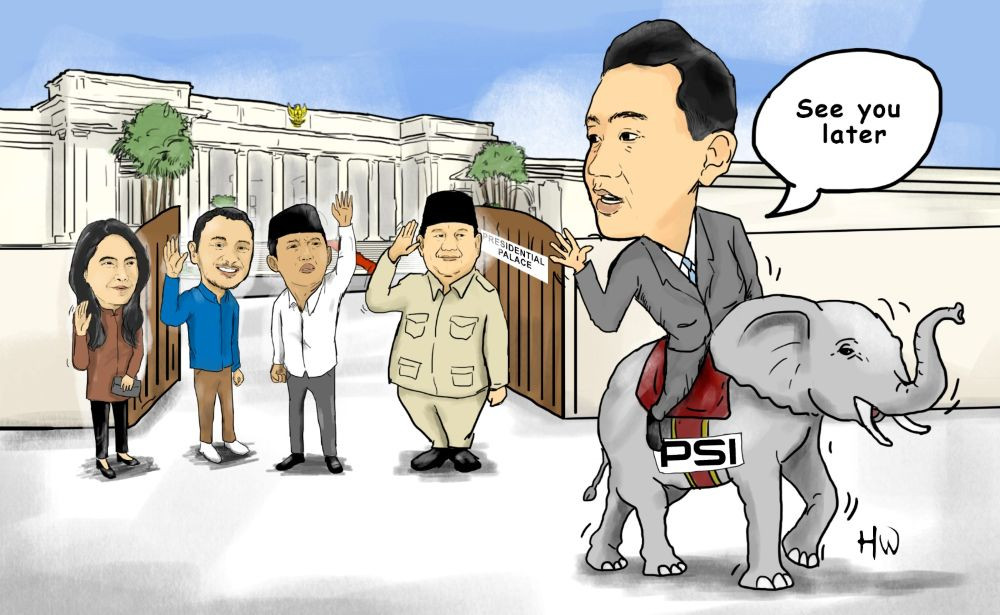
Gibran quit cartoon (JP/Hengky Wijaya)
Gibran Rakabuming Raka’s exit is about more than his pedigree. It shows how Indonesia’s millennials, and the generation behind them, reach power — and why so many cannot.
What do an equivalency certificate, an artificial intelligence chip titan’s scandal and a public-school teacher have in common? Within 10 days this month, each told the same story about how power is won – and how it is taken back.
The certificate belonged to Vice President Gibran Rakabuming Raka, 39, who quit on Nov. 12 after the Supreme Court voided it. The titan is Jensen Huang, who stepped down from Nvidia days after admitting to an affair with a woman whom United States intelligence reportedly suspects of espionage for China, despite public backing from the White House. The teacher is James Talarico, 37, who won a US Senate seat in Texas on Nov. 3.
Together, they illustrate two distinct paths and a shared generational context. In the US, a young candidate climbed open rungs, while a powerful executive’s patrons could not shield him. In Indonesia, the ladder to power exists on paper but remains rickety, and the trapdoors open the moment a patron withdraws support. For millennials, born between 1981 and 1996, and Generation Z behind them, that is this month’s real lesson.
Fairness first. In the three-way 2024 presidential race, Prabowo Subianto and Gibran won 58.59 percent of the vote in a single round. No court ruling or commentator can erase that electoral mandate.
Yet the path onto that ballot was not one most young Indonesians could take. Gibran, the eldest of the seventh president, Joko “Jokowi” Widodo, became mayor of Surakarta in 2021. Two years later, he secured a vice presidential candidacy through a Constitutional Court decision issued under a chief justice who was his uncle by marriage and who was subsequently removed from that post by an ethics council.
Gibran’s exit proved to be as opaque as his entry. After the Supreme Court on Oct. 30 annulled the letter certifying his foreign schooling as equivalent to a senior high school diploma, factions in the House of Representatives moved toward impeachment. A day after vowing to contest the ruling in the State Administrative Court (PTUN), Gibran resigned.
None of this proves that young people cannot govern. It proves that the path to power matters.
Talarico’s trajectory ran in the opposite direction. After teaching in a public school, he won a seat in the Texas House of Representatives at 29, defeated a sitting congresswoman, Jasmine Crockett, in a bruising primary, and went on to unseat Republican Attorney General Ken Paxton in a state his party had not won statewide since 1994. Campaigning on affordability and against the influence of big money, Talarico was carried to victory by young voters.
The US has its own political dynasties and campaign finance flaws; it is no flawless template. However, every rung Talarico climbed was open, contested and decided by the electorate. Both he and Gibran won major elections, yet only one reached the ballot through rungs he climbed himself.
Huang’s downfall demonstrates the limits of patronage. Few executives have stood closer to political power. US President Donald Trump called him “honorable” and urged him to remain in his post, while Commerce Secretary Howard Lutnick had long praised him. CNN reported that Trump was briefed on the espionage concerns as early as May. Although the allegation, first reported by The New York Times, remains unproven – no charges have been filed, and Beijing has dismissed it as a smear – the backing of the world’s most powerful patron bought Huang only days. Patronage delayed the reckoning; it could not prevent it.
In Indonesia, by contrast, patronage remains the decisive currency. Gibran’s rise and fall both tracked his patrons: his father’s endorsement enabled his candidacy, and the withdrawal of elite protection ended it. Accountability arrives when a patron changes course, not when institutional rules are triggered.
For Gibran’s generation, the ladder exists on paper through local and national elections and state-run equivalency programs, yet it remains inaccessible to most. Party elites select candidates centrally, nominations are widely reported to require informal payments, candidacy thresholds remain steep and open primaries do not exist.
The very first rung is a credential millions never had the opportunity to earn. According to calculations from Statistics Indonesia (BPS) 2020 census data, nearly half of the country’s 69 million millennials – roughly 34 million people – never completed senior high school. Yet that diploma, or its recognized equivalent, is legally required to run for the House, regional legislative councils, regional executive offices, the presidency and the vice presidency. Half a generation is effectively barred from nearly every elected office above the village level.
That ceiling is now passing to Gen Z. Unemployment among 15- to 24-year-olds rose to 17.37 percent in May even as the national rate declined, with graduates of vocational high schools (SMK) facing the highest jobless rate of any educational cohort. For three weeks, the nation debated one man’s certificate. For millions of young Indonesians, a missing or undervalued credential is no political scandal – it is an economic and civic ceiling.
Building a sturdier ladder requires four reforms.
First, eliminate the diploma veto. Lawmakers should revise the senior high school requirement in the 2017 General Elections Law and the Regional Elections Law. Voters, rather than certificates, should judge fitness for office; at a minimum, recognized prior learning and professional experience should qualify as equivalent.
Second, widen access to the first rung by offering free, flexible Paket C equivalency programs at every community learning center (PKBM), integrated with vocational training so that a diploma and a marketable trade arrive together.
Third, democratize candidate selection through internal party primaries, lower nomination thresholds and transparent campaign finance rules.
Fourth, enforce accountability before the ballot, not after. The General Elections Commission (KPU) should publish candidates’ credentials and open a public challenge window during verification so that electoral mandates are not undone by the courts years later. And when a vacancy arises, as in the vice presidency today, the People’s Consultative Assembly should publish clear selection criteria and hold public hearings for all nominees.
Young Indonesians, for their part, must reject the two roles the political elite routinely offers them: paid extras in borrowed university jackets, as seen at a Jakarta rally on Oct. 29, or unquestioning loyalists to a patron. Talarico succeeded because young voters acted as constituents with a clear policy agenda, not as a fan base.
In a republic, the ballot decides who governs; education decides who may ever stand on it.*
Adi Abidin is a public policy specialist at Kiroyan Partners and a political science graduate of Northern Illinois University in the United States. The views expressed are personal.
Source: The Jakarta Post, November 16, 2026.
Download the clipping here.