
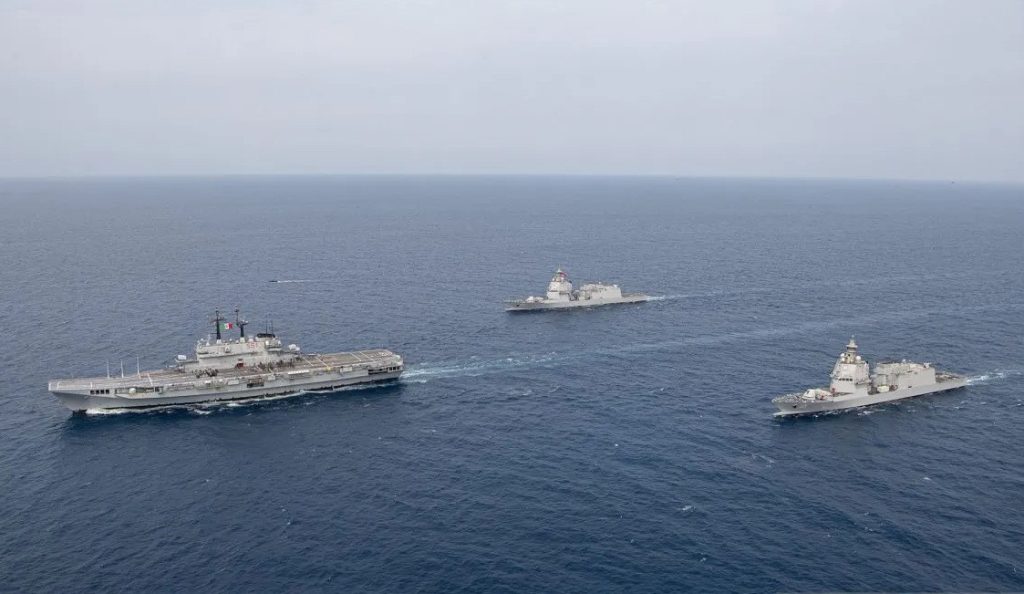
The newly acquired aircraft carrier Giuseppe Garibaldi (left), now KRI Sriwijaya, is accompanied by KRI Brawijaya (center) and KRI Prabu Siliwangi as they sail past Bangka waters on Sept. 17, 2026. (Antara/M Risyal Hidayat)
To justify its steep price tag, Indonesia’s first aircraft carrier must balance realistic support roles against the risk of becoming a costly ceremonial white elephant.
KRI Sriwijaya, formerly the Italian Navy’s Giuseppe Garibaldi, has arrived in Indonesia. Its first formal assignment will likely be the fleet review during the Indonesian Military (TNI) anniversary celebration on Oct. 5, where it will take center stage as the nation’s first aircraft carrier.
With the acquisition concluded, the debate over whether Indonesia needs an aircraft carrier is effectively settled. The more pressing question facing the Defense Ministry is how to operate a 45-year-old platform to justify the substantial public investment required to keep it afloat. Realizing that value will require tempering strategic expectations with fiscal reality.
Public expectations, in particular, demand recalibration. Aircraft carriers were once seen as decisive capital ships, largely due to Allied victories in the Pacific theater of World War II. In the initial post-war decades, several middle powers acquired surplus carriers from the United States and the United Kingdom, only to find that their strategic utility rapidly eroded. Hulls displacing 18,000 to 24,000 tonnes, larger than Garibaldi, became increasingly vulnerable to long-range strike weapons.
Historical precedent is instructive. The Royal Netherlands Navy kept HNLMS Karel Doorman near Hollandia (now Jayapura) during Operation Trikora in early 1960s, guarded against Indonesia’s newly acquired anti-ship missile-armed bombers. After its sale to Argentina as ARA Veinticinco de Mayo, the ship sat out the Falklands War against the UK.
Brazil experienced initial operational success with NAeL Minas Gerais, yet during the vessel’s final three decades, it was largely port-bound by spare-parts shortages and chronic budget constraints.
The Defense Ministry must acknowledge that a light carrier displacing 14,000 tonnes, limited to rotary-wing aircraft and medium-sized unmanned aerial vehicles, cannot serve as a credible deterrent in high-intensity modern warfare. Even the US Navy has exercised caution regarding the deployment of supercarriers near the Strait of Hormuz during flare-ups with Iran.
Deploying KRI Sriwijaya as an anti-submarine warfare (ASW) hub matches its original Cold War design, as some defense analysts have recommended. Yet developing a carrier-based ASW capability requires considerable capital expenditure, particularly given the TNI’s limited inventory of dedicated ASW helicopters. Even if airframes were abundant, frigate-based ASW remains a more cost-effective choice for the Indonesian Navy, offering superior agility, speed and sensor integration for littoral submarine tracking.
Consequently, KRI Sriwijaya’s primary military utility lies in serving as a command platform with light air support. Embarking roughly a dozen aircraft, it is well suited to function as a mobile hub for joint rotary operations. This setup would allow the Navy to train Army and Air Force aviators in maritime flight operations, a sensible initiative given the Navy operates only about 30 of the country’s 140-plus military helicopters. However, non-naval airframes will still require costly marinization to operate reliably in saltwater environments.
The Defense Ministry has also indicated that KRI Sriwijaya will prioritize non-combat missions, especially humanitarian assistance and disaster relief (HADR). While pragmatic, this mission profile must be weighed against existing fleet assets.
The Navy currently conducts HADR operations using five Makassar-class landing platform docks (LPDs). While these LPDs accommodate fewer aircraft, their well decks deploy landing craft capable of offloading heavy machinery, vehicles and high-volume aid directly onto unimproved shores.
In major relief efforts, two Makassar-class LPDs, with a combined displacement of roughly 22,000 tonnes, deliver far greater practical utility than a single light carrier. Although KRI Sriwijaya can embark double the aircraft, disaster response hinges on heavy logistics and bulk supply distribution rather than sustained airlift alone. Its optimum HADR role is therefore to complement LPDs as a command-and-control node and triage station, not replace them.
Above all, carrier operations demand immense sustained funding. During the 2006 Lebanon crisis, the Italian Navy incurred 150,000 euros (roughly US$172,000) per day solely in sailing costs for Garibaldi. Comprehensive operating expenditures, factoring in personnel, routine maintenance, supply chains and aviation operations, routinely run two to three times higher.
Because naval surface assets typically spend one-third of the year deployed, these escalating costs explain why middle powers like the Netherlands, Argentina and Brazil ultimately abandoned carrier aviation.
Maintaining an aging, second-hand hull is often more expensive than maintaining a modern build, especially when parts are out of production. The Defense Ministry’s retrofit and modernization program must prioritize fundamental seaworthiness and hull life over complex combat suites. The goal should be operational sustainability rather than high-end lethality.
Joint operations will compound these expenses. The disparate helicopter types across the three service branches complicate shipboard interoperability and standard marinization can increase airframe life-cycle maintenance costs by 20 to 30 percent. Unchecked, KRI Sriwijaya risks draining defense funds from core operational requirements, such as offshore patrol vessels, additional amphibious ships, utility helicopters and coastal radar networks.
Finally, the government must ensure that the carrier’s $450 million retrofit and long-term sustainment directly benefit Indonesia’s domestic shipyards, rather than reducing national defense firms to integration subcontractors for foreign suppliers. Without a clear plan prioritizing fiscal balance and domestic industrial participation, KRI Sriwijaya risks becoming an expensive ceremonial showpiece with limited strategic return.*
Rahmad Budi Harto is a Lead Consultant at Kiroyan Partners. His work covers public affairs and strategic communications, with an interest in defense, national security, and policy issues.
Source: The Jakarta Post, September 24, 2026.
Download the clipping here.