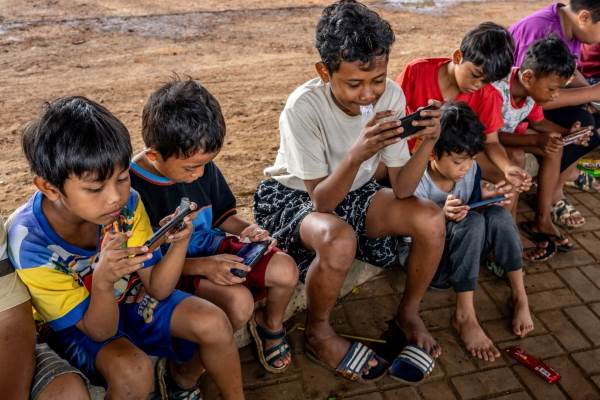
KATADATA/ BINTAN INSANI
The rise of social media has brought cases of sexual violence in academic settings into public view. What began as a single post on X that drew widespread attention exposed online sexual violence involving sixteen students from the Faculty of Law at Universitas Indonesia (FHUI), affecting fellow students and academic staff. The case has since been acknowledged and acted upon by both the faculty and the university.
In such cases, social media functions as an accelerant: amplifying visibility, intensifying public pressure, and shaping broad public opinion that frames sexual harassment as a clear social deviance. It also enables the rapid identification of alleged perpetrators and the imposition of large-scale social sanctions, often presumed to produce a deterrent effect.
Nearly 28 years into Indonesia’s Reformasi era, freedom of expression has found broader channels through social media. Critical issues such as sexual violence often surface only after being amplified online, reinforcing the troubling notion: “no viral, no justice”.
While social media has become an alternative arena for seeking justice, it also introduces a fundamental distortion: the shift from justice for survivors to public consumption.
A post by the @sampahfhui account prompted FHUI’s academic community to convene an open forum, bringing together faculty members, students, and alumni, and broadcast live to an audience of millions. Intended as a mechanism of accountability, the forum instead devolved into a site of collective judgment, both offline and online.
Comments calling for expulsion and mocking the perpetrators’ physical appearance circulated widely. The livestream was shared as a civic process, but as spectacle: something to watch, consume, and react to. Justice was displaced by performance.
In the end, the forum became viral content, sensational, consumable, and ultimately leveraged to drive attention and engagement. Narratives of questionable accuracy, including personal details about the alleged perpetrators, spread freely, further diverting focus from the central issue: standing with survivors.
The critical question, then, is this: Does such a process truly advance the rights of survivors?
Much of the public discourse instead fixated on the perpetrators’ morality—whether they felt remorse, whether they considered the women in their lives—rather than centering the perspectives and lived experiences of survivors. Only a few voices meaningfully reflected survivors’ accounts, often limited to those closest to them.
This is not an isolated phenomenon. Numerous sexual violence cases that surface on social media are reduced to public consumption, fuel for judgment and persecution.
When a survivor shared her experience of harassment by an employee of a private bank during an online meeting, netizens quickly circulated the perpetrator’s name and social media accounts.
In another instance, cases involving the abuse and exploitation of minors even generated “bounties”— crowdsourced funds aimed at identifying and locating the perpetrators. Yet this collective energy is overwhelmingly directed toward pursuing punishment, rather than restoring survivors.
Deterrence is undeniably important in breaking the long-standing normalization of sexual violence in Indonesia. According to the Komnas Perempuan (Indonesia’s National Commission on Violence Against Women) (2026), of 376,000 reported cases of gender-based violence against women, only around 2,000 have reached a judicial verdict. This reveals a critical truth: the core issue is not a lack of exposure, but systemic barriers within the justice process itself.
Sexual violence is not merely an individual deviation. It is a manifestation of deeper structural failures within social and legal systems that have yet to effectively break the cycle of violence against women.
Punitive approaches remain the dominant framework in addressing cases of sexual violence. Yet when punitivism becomes the sole lens, two fundamental problems emerge. First, it reproduces the very logic it seeks to combat: attempting to resolve violence through violence. Second, it sidelines survivors, failing to position them as the central subjects in the pursuit of justice.
Punitivism, when made the default response, does not ultimately serve survivors. Publicly exposing perpetrators’ background, personal connections, and everyday behavior does little to ensure survivors’ safety or dignity. Instead, mass judgment and public persecution offer no meaningful pathway toward recovery.
As an alternative, restorative justice is gaining traction as a more holistic approach—one that moves beyond punishment to include rehabilitation and reconciliation for survivors and all affected parties. It seeks not only to protect those who have experienced violence but to transform systems at their roots, ensuring such harm does not recur.
Those subjected to sexual violence are not merely “victims”, but survivors. This distinction matters. Survivors are not passive recipients of harm, dependent on perpetrators’ remorse or systemic goodwill, or reduced to objects within the churn of social media posts. They are active agents: defending themselves, challenging systems, and working to prevent others from enduring the same cycle of violence.
Social media has created space for women to speak out about their experiences of sexual violence. Yet, it should not become the only reporting mechanism, one that perpetuates the logic of “no viral, no justice”.
Without safe, independent, and survivor-centered reporting systems, social media will continue to function as the de facto courtroom, with all its distortions.
As users, we must recognize the power of social media as an open and inclusive space for expression, for advocacy, and for accountability. Responsible engagement is not merely about avoiding the harmful or misleading narratives, but about actively upholding the rights of women and other marginalized groups.
By centering survivors’ perspectives, we can begin to reclaim social media, not as a stage for spectacle, but as a tool to demand systemic reform and to build environments that are safer, more just, and more humane for women today and in the future.*
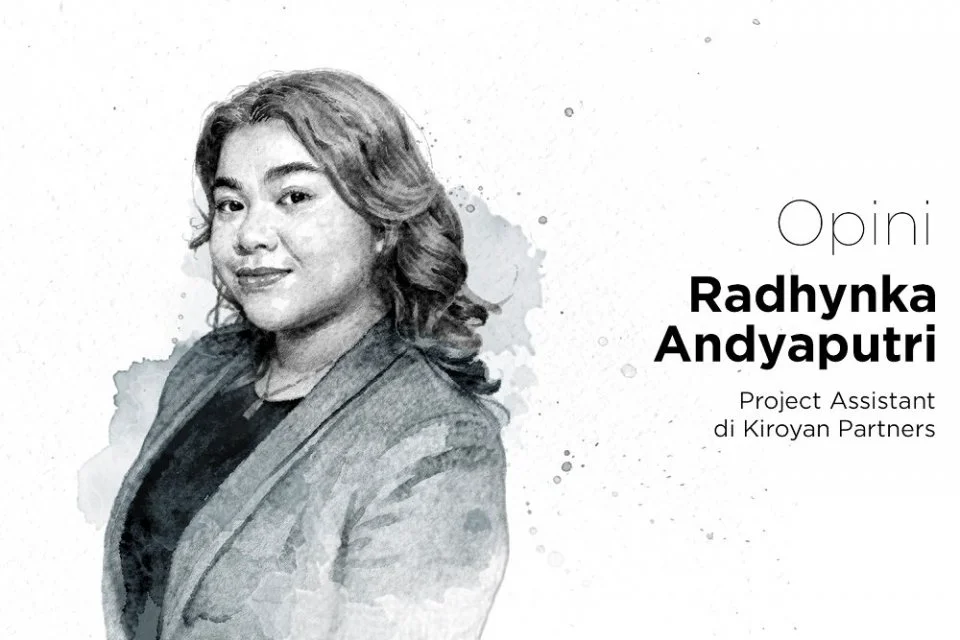
Radhynka Andyaputri, Project Assistant, Kiroyan Partners. The views expressed are personal.
Source: Katadata.co.id, May 6, 2026.
Download the clipping here.