KATADATA/ BINTAN INSANI
These days, the phrase demographic bonus is no longer heard as frequently in discussions about Indonesia’s future economic growth. Not long ago, it was widely promoted as one of the country’s key advantages in achieving stronger long term growth.
Indonesia has indeed maintained economic growth of around 5 percent for nearly three decades. However, the persistence of growth at this level may not reflect an economic engine operating at full capacity. Instead, it may signal that the country is caught in what economists describe as the middle-income trap.
Productivity growth has slowed. Innovation capacity remains limited. The transition toward a high-skill, high-wage economy is still incomplete. Economic expansion increasingly relies on adding more workers rather than raising productivity.
In other words, a demographic bonus does not automatically translate into an economic dividend.
Common diagnoses have long been recognized, including infrastructure gaps, regulatory complexity, skill mismatches, and limited research and development intensity.
Yet there is another barrier to competitiveness that receives far less attention from policymakers: the female labor force participation rate, or FLPR.
In 2025, women’s labor force participation in Indonesia reached 56.7 percent. This represents progress after nearly two decades of stagnation at around 51 percent. In recent years, it is also increasingly common to see major companies led by women.
However, this improvement masks deeper structural weaknesses.
The participation gap between men and women remains wide at around 27 percentage points. Nearly 63 percent of working women remain concentrated in the informal economy, where income stability and social protection are limited.
At the same time, a striking mismatch exists between education outcomes and employment opportunities. Women are increasingly outperforming men in completing higher education, yet only around 36.6 percent have secured formal employment.
This disconnect represents a missing link in Indonesia’s growth strategy. A significant pool of highly educated female workers remains underutilized.
Women as a Key Driver of Progress
This imbalance helps explain why Indonesia’s economic growth has struggled to break beyond its current ceiling. In effect, the country has not yet fully mobilized either the size or the quality of its productive workforce.
Research from the World Bank and the Asian Development Bank consistently shows that demographic bonuses do not automatically produce economic growth. The dividend materializes only when the working-age population is actively integrated into the labor market.
In this context, low female labor force participation means that part of Indonesia’s demographic potential is not converted into economic output. Economists often describe this situation as an incomplete demographic dividend.
From this perspective, low female participation is not merely a gender equality issue often highlighted during International Women’s Day. It is a structural inefficiency in the economy.
At a time when productivity growth is slowing, Indonesia has yet to activate one of its most readily available sources of growth: educated female workers.
Without addressing this gap, the demographic bonus risks becoming a missed opportunity rather than a true growth engine.
Conversely, increasing women’s participation could become one of the most realistic levers for boosting productivity, expanding the formal workforce, and helping Indonesia move beyond the middle-income trap.
The urgency to strengthen women’s participation in the economy is also increasing as Indonesia accelerates its green transition.
The country is positioning itself as a key player in the global electric vehicle and battery ecosystem. This ambition is supported by nickel downstreaming policies, commitments to energy transition, and partnerships with major manufacturing players.
While these ambitions are economically sound, large-scale transitions of this kind extend beyond technological change or shifts in revenue sources. They are also profound social transformations that carry risks and opportunities across communities, including for women.
In many regions most exposed to energy transition projects such as coal dependent areas in Kalimantan, coastal communities, and rural regions experiencing land use change and resource pressures, women are often the first to experience the impacts.
They manage household financial pressures, maintain food security amid economic volatility, and sustain social cohesion when local economies are disrupted.
International evidence consistently shows that resource governance and energy transition programs are more durable and equitable when women play meaningful roles in consultation, oversight, and planning.
This is not simply a matter of symbolic inclusion. It is about implementation effectiveness.
Transitions that overlook gender perspectives often face community resistance, social friction, and uneven economic outcomes.
Indonesia’s green transition could encounter similar pressures if women continue to be positioned merely as passive recipients of change rather than as active enablers of structural transformation.
At the same time, there is an underexplored market opportunity.
The green economy is opening new sectors, from decentralized renewable energy services for remote communities to sustainable supply chain verification, green logistics, and community based conservation financing.
Indonesian women entrepreneurs are already active in many of these emerging sectors. However, access to formal credit, growth capital, and impact investment remains limited for women led enterprises.
Closing this participation gap is therefore not only about social inclusion. It is also a strategy for strengthening competitiveness.
Countries that mobilize capable entrepreneurs early in the formation of new markets gain a structural advantage.
Amid growing geopolitical pressures globally, Indonesia actually occupies a relatively strategic position. Its membership in the G20, its central role within ASEAN, and the growing maturity of its private sector create space for broader economic leadership.
In this context, Indonesian women in business, finance, and public affairs represent a strategic resource that remains significantly underutilized.
One practical step worth serious consideration is leveraging the ASEAN Women’s Green Economy Pact as a policy platform that integrates financing for women led enterprises, energy transition investment, and governance reform.
The pact should move beyond declarations and be operationalized through ASEAN ministerial processes, supported by blended financing mechanisms and measurable accountability frameworks to ensure real and sustained impact.
If designed effectively, Indonesia could play a stronger role.
The country already stands at the intersection of several strategic issues: critical minerals, energy transition financing, and regional economic diplomacy. Aligning these strengths with a more deliberate strategy to expand women’s economic participation would send a powerful signal about the region’s development trajectory.
Indonesia therefore needs a more ambitious agenda to realize the target of 65 percent female labor participation, as envisioned by Bappenas in the Indonesia Emas 2045 vision.
However, this does not mean that the structural barriers facing Indonesian women will disappear quickly.
Gaps in care infrastructure, workplace bias, and unequal access to capital remain real constraints that require sustained policy attention.
It is time to recognize that women’s economic participation is not merely a matter of social inclusion. It is a necessary condition for strengthening Indonesia’s economic growth and competitiveness.*
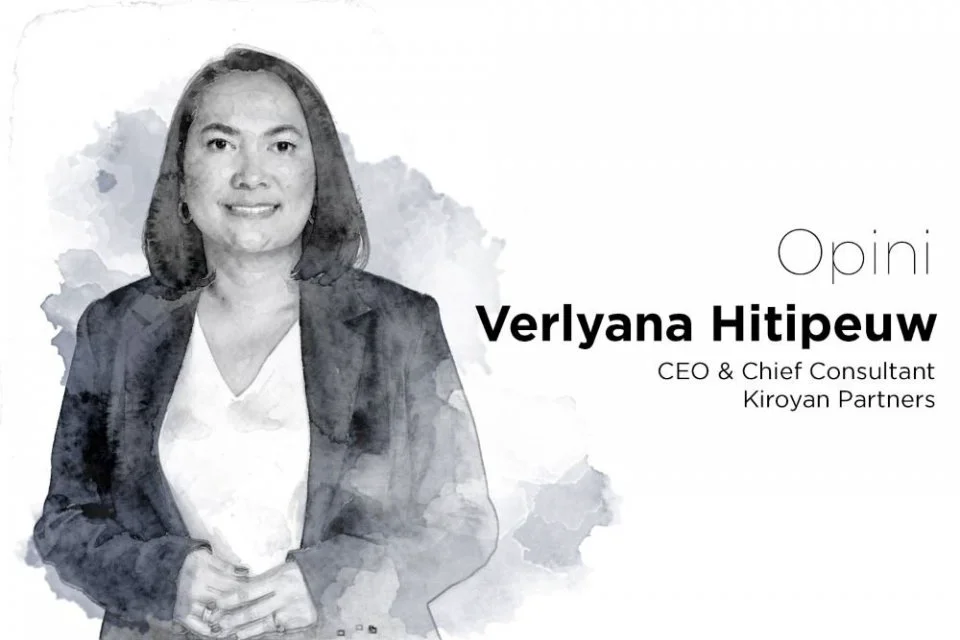
Verlyana Hitipeuw, CEO & Chief Consultant, Kiroyan Partners. The views expressed are personal.
Source: Katadata.co.id, March 9, 2026.
Download the clipping here.