
The theme selected by the women’s ministry for Hari Ibu 2025 proposes a shift to a pragmatic, inclusive strategy that embraces women leaders’ creativity and resilience toward achieving the country’s centennial vision.
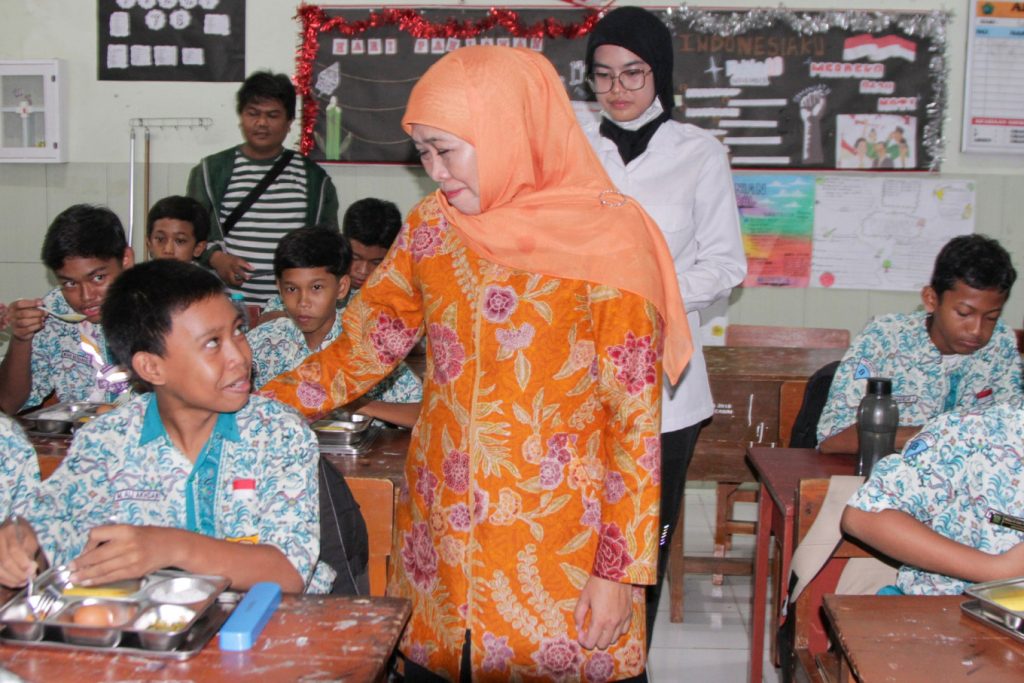
East Java governor-elect Khofifah Indar Parawansa (center) engages with a student on Jan. 8, 2025, during a visit to inspect the implementation of the free nutritious meal program at SMPN 1 Candi junior high school in Sidoarjo, East Java. (Antara/Umarul Faruq)
This year’s commemoration of Hari Ibu (Women’s Day) carries an unusually clear policy signal. The Women’s Empowerment and Child Protection Ministry’s theme, “Perempuan Berdaya dan Berkarya, Menuju Indonesia Emas 2045” (Women with agency and creativity, toward Golden Indonesia 2045), is not ceremonial rhetoric but a strategic proposition for Indonesia’s next two decades.
As the country approaches its centennial, it must pivot away from extraction-driven growth and institutional short-termism toward a development model that is resilient, inclusive, and adaptive to disruption. This transition cannot be achieved through infrastructure and regulation alone; it requires leadership capable of navigating uncertainty, mobilizing creativity, and sustaining social trust.
In this context, women’s leadership rooted in agency (berdaya) and productive creativity (berkarya) becomes central rather than complementary. Three public figures illustrate how these qualities translate into engines of long-term growth.
Take Nurhayati Subakat, the entrepreneur behind Paragon Technology and Innovation and the Wardah brand. Her approach reframed the need for halal and culturally resonant beauty products from an assumed market constraint into an opportunity for brand differentiation, supply chain development, and greater domestic value creation.
That kind of reframing is not decorative innovation: It is strategic market creation.
More importantly, Nurhayati invested deliberately in internal capability: R&D, distribution networks, and managerial training that converted brand recognition into sustainable employment and export potential. In doing so, she expanded opportunities for women across her organization and invested in the support systems needed for them to thrive.
Her experience shows that creativity, when applied as a disciplined business strategy, can expand domestic productive capacity rather than simply redistribute short-term gains.
In education, the work of Najelaa Shihab demonstrates how creative leadership reshapes human capital at scale. From founding progressive schools to piloting learner-centered networks, her initiatives focus on redesigning how learning responds to complexity through blended models, stronger teacher networks, and deeper family engagement that treat education as an ecosystem rather than a pipeline.
This matters for the pivot because adaptable learning systems produce a workforce that can absorb technological change and bounce back from disruption. Najelaa’s practical insistence on curricula that develop critical thinking, as well as on teacher professional development that emphasizes problem-solving, turns creativity into a credible engine for future productivity.
In the public sector, East Java Governor Khofifah Indar Parawansa is known as not only an astute politician but also a leader who has pursued inclusive governance as a driver of resilience. Through policies expanding women’s economic participation, supporting village welfare, and integrating gender-responsive budgeting, she treats inclusion not as a social add-on but as a core instrument of economic stability.
When local administrations embed participation and protection into planning and fiscal choices, they widen the base of economic activity and reduce the fragility that follows from exclusion. In other words, inclusive policy design produces measurable returns: higher program uptake, improved service continuity, and stronger community readiness when shocks occur.
What do these examples have in common? They have converted two leadership capacities, namely creativity and resilience, into organizational and societal mechanics that produce durable growth. Creativity here is the capacity to reframe constraints as design problems and to prototype pragmatic solutions.
Resilience is not stoic endurance; it is the deliberate engineering of redundancy, learning loops, and adaptive governance so that shocks become opportunities for improvement rather than sources of permanent decline.
To translate these qualities from exemplar projects into national strategy, we must be more precise about what we choose to measure. For firms, this means looking beyond headline quarterly returns toward indicators of durability: revenue stability across cycles, employee retention, and the speed of post-shock recovery.
At the community level, this means paying attention to household income volatility, diversification of livelihoods, and continuity of essential services.
In public policy, programs should be judged by uptake, equity of reach and improvements in human capital outcomes rather than by political visibility alone.
The Women’s Day theme provides the language, berdaya and berkarya, but the pivot demands that this language be translated into metrics that hold institutions to account.
There are practical steps that follow from this measurement imperative.
One priority is for the central government and local administrations to adopt outcome-based gender key performance indicators (KPIs) within broader resilience planning. This involves tracking how gender-responsive budgeting affects service coverage in health, education, and social protection and how those shifts, in turn, shape local economic resilience.
In the private sector, women’s creative leadership should be recognized as a strategic asset, with diversity and succession planning embedded into corporate performance frameworks rather than treated as compliance exercises.
Finally, education and civil society funders can play a critical role by prioritizing ecosystem models that link classroom innovation with community livelihoods and labor market pathways. Investment in teacher networks and parental engagement yields returns long after any single pilot closes.
All these reforms require a cultural shift. Indonesia’s aspiration to become an advanced nation by 2045 will only be realized through the steady accumulation of capability: organizations that endure and improve through crisis, education systems that continually renew workforce readiness, and regional governments that distribute opportunity rather than concentrate fragility.
Nurhayati, Najelaa, and Khofifah illustrate what “Perempuan Berdaya dan Berkarya” can achieve when it is treated not as a slogan but as both a policy design principle and a performance objective.
That is the pragmatic path to Golden Indonesia 2045 and a fitting way to honor Hari Ibu for what it sets in motion: entrusting women’s creativity and resilience with the authority and resources to lead Indonesia’s long-term transformation.*
Verlyana Hitipeuw is CEO and Chief Consultant at Kiroyan Partners.
Source: The Jakarta Post, December 20, 2025.
Download the clipping here.